Showing posts with label mosaic monday. Show all posts

Sunday, September 29, 2019

September Ends


The last weekend of September can be melancholy. Summer is officially over and autumn is well and truly here. This year, September is ending with lots of sunshine.

My dahlias were slow to bloom this year, and it seems that they are just reaching their peak blooms now. Hopefully, they will continue for a few more weeks. The one above is called Sweet Violet and can bloom in a variety of colours, from white barely tinted with violet to all violet. 


I went for a long and solitary walk along the water this afternoon. Tim was busy with something unexpected at work. It's much more fun when he's along, but I enjoyed the wonderful views across the water. Lots of people were out enjoying the sunshine. 


Scenes along the way - a cluster of small stones cradled in a driftwood log, probably tossed there by the waves - golden grasses against the layers of blue water and blue mountains across the strait - a large rusting flat-head nail jutting up from the split rail fence along the cliff.


Then there was this line up of gulls perched on the peak of a roof. The building is lower than the pathway and the gulls were not much above my head. How different they all are - birds in a row. Made me grin.


I rushed the season a bit and started reading the October edition of Country Living early. I usually like to save them until the proper month, the one on the cover. Do you do that? Or would you read it as soon as it arrives?


Another bouquet of flowers from the garden yesterday - dahlias and hydrangeas. I'll clip as long as I can. 


Today we turned the gas fireplaces on as the house is beginning to get chilly. It's time for cozy meals like the one I made for today's dinner - Mushroom and Garlic Chicken Thighs, Couscous, and Broccoli. Cozy will be the goal for many months ahead. 

How is your end of September? Parts of B.C. and Alberta received lots of snow these past few days. Is it snow, rain, or sun for you?

Linking with Mosaic Monday, hosted by Angie of Letting Go of the Bay Leaf. 

Sunday, September 22, 2019

Clam Castle


There is so much recorded history in Europe. Stories reside in every nook and cranny of old buildings and villages. In Grein, we took a short walking tour of the town that included an old theatre as well as the usual church and village square. 


The Danube is prone to flooding and 2013 was a bad year. The Austrians have come up with some ingenious engineering to create temporary walls to hold back up to 15 feet of water. However, not all of the town was protected and the waters crept up the streets, creating a lot of damage. 


The river looks so peaceful here, but if you search for 2013 Danube floods, you'll see many videos of raging water. 


Later, we took a bus to Castle Clam. Our tour was conducted by the Count himself, a young man in his early 40s who lives there with his wife and three children. He was very engaging, although it felt a bit odd, as if we were intruding a little. However, conducting tours helps to maintain the castle. The castle has been in this family for 16 generations, since 1454. I find that amazing. 
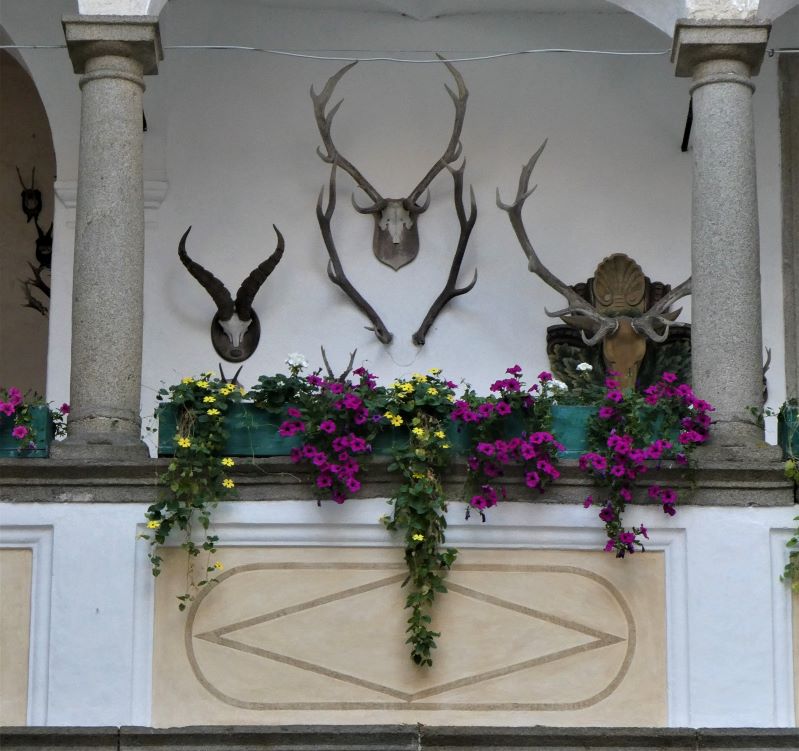
The tour began in the central open courtyard where a balcony runs along the second floor, seen above. The Austro-Hungarian Emperor Franz Joseph I enjoyed hunting and came here to visit and hunt. Some of the trophies mounted on the walls (and there were a lot of them) were shot by the Emperor. I preferred the flower boxes. 


We climbed a narrow, twisting staircase to the small medieval chapel where the Count told us Mass is still held. He said that celebrations, such as birthdays and Christmas begin with Mass here. It was quite something to imagine the many years of worship that went on and continue to the present. 

The family lives in a separate wing from the tour. I enjoyed seeing how the public rooms were furnished and set up as if someone had just stepped out of the room for a moment. 


One of the most impressive rooms is the dining room where the table was set with Meissen porcelain and fine crystal. The Count told us that this room is still where Christmas dinner is held. He grinned as he said that they use different dishes, as these are priceless, and with children and dogs in the room, breakages are inevitable. 

Just before entering the room he pointed out a portrait of one of his ancestors. He asked us to notice that his arm was in a sling. Casually he mentioned that this particular gentleman was one of three thrown out of a window in Prague during the Second Defenestration! You might remember that I mentioned the event a few posts back.  I was quite tickled to make this connection from one historical site to another. 


Clam Castle also holds big music festivals. Elton John, Pink, and others have performed there. The castle grounds produce wine and we were treated to a snack and a glass of wine before leaving. 

Here at home the trees are beginning to change colour and when I walked today, leaves swirled down from the trees. The heat of summer seems distant now. I'm loving going through my photos and remembering our wonderful trip.

Linking with Mosaic Monday, hosted by Angie of Letting Go of the Bay Leaf. 

Monday, September 16, 2019

St. Florian's Monastery


Today's look back at our European Adventure takes us to St. Florian's Monastery in northeast Austria. Tim opted to go on a bike tour while I chose to visit the monastery. My thinking was that I can go biking any day, but Baroque architecture and history are hard to come by in our region. 

St. Florian was a Roman soldier who ran into serious trouble for NOT persecuting Christians, and who became a Christian himself. Although condemned to be burned at the stake, he was thrown into the river with a millstone hung about his neck. As a result, he became the saint of floods and firefighters.


Our tour began in the crypt below the church, where the first church on the site began in the 900s. St. Florian is buried here, along with a lot of other people. In the top left corner of the mosaic above, you'll notice the ornate coffin of Anton Bruckner, the Austrian composer. Behind the coffin is an ossuary of some 6000 Christians whose bones were retrieved during some phase of building. The bones are neatly stacked in rows behind iron grills. It was a little freakish. 


From the cellars we climbed upstairs to the church which is full of light and loveliness. The ceiling is very ornate, but if you look very, very closely, you'll see that the ceiling frescos are trompe l'oeil, (fool the eye), and that the stucco work is painted, not 3-D, unlike the white pillars below. 


Anton Bruckner was a choir boy here, and loved to play the organ, seen above. His coffin is directly below the organ, when the organ is played, the music is heard in the crypt below. 


We wandered through long white hallways with marble floors and wide arches that opened to the courtyard below. I can't help thinking that it would have been very chilly to go from one room to the next in the winter cold. 

Our guide gathered our group together in front of a set of beautiful wooden doors with inlaid patterns and told us we would be seeing the library next. 


My heart went pitter patter when I stepped into the room. It is truly magnificent. Such a richness of books - 150,000 of them - on gorgeous wooden shelves reaching high, high to the ceiling. Sets of beautifully bound volumes filled the shelves - white, blue, brown, with the occasional red. Light poured in through tall windows set between the bookshelves. 


Hidden doors at each end of the room allow the curved shelves to open for access to the next rooms, also used for books. This is a working research library and when we entered a young man slipped quietly through the door to allow us our time in this magical space. I could have stayed all day. Our guide didn't hurry us at all, but allowed us to soak in the atmosphere and ask questions. Such richness.

How about you? Bike ride or monastery? Tim enjoyed his ride and the guide told the group about the history of the area. 

Linking with Mosaic Monday, hosted by Angie of Letting Go of the Bay Leaf. 

Monday, September 09, 2019

Cruising the Danube


For our second week in Europe we enjoyed a river cruise along the Danube. This was our second cruise with Avalon Waterways and we have only good things to say about it. Delicious food, attentive staff, wonderful excursions, and so much more. We loved being able to slide open our stateroom windows and lean over the railing to watch the water drift by. 

All river cruise boats are roughly the same width and length because of the lock system along the rivers. Balconies have to fit within that width and Avalon came up with the great idea of having the windows slide fully open to give the sensation of a balcony without losing space within the room. 


On our first morning we woke up to the sight of green forested hills, utter quiet, and a small village, Engelhartszell, dominated by the Trappist Monastery. Founded in the late 1200s, the monastery has had its ups and downs with changing politics, religious differences, and fires. 


Tim and I took an early morning stroll around the village of well-tended homes and gardens. The blue building above is so beautifully maintained with its detailed paint work, and was built in 1598, according to the sign. 


Later, we toured the Monastery and learned more about its history. The church is a beauty, rebuilt in the 1700s in Rococo style. The ceiling fresco above contrasts dramatically with the one below. 

In the 1950s a fire destroyed part of the interior of the church, including one of the ceiling frescoes. The monks were told there was no money for restoring it in the style of the other frescoes, so a local artist, using the same paint colours, created a cubist fresco in 1957. I like the way it reflects the changing times of history although the differences were quite startling when I first walked into the building. 


In the grounds of the monastery is a garden and park that is open to all, and a playground and aquarium designed to educate visitors about the ecology of the Danube and the surrounding landscape. 


The monks began producing beer and cheese to augment their living. Although the production is now done by others as the monks are aging, the beer is still produced locally. We tasted three of them - I barely sipped as I don't really like beer at all. However, the cheese was great! They also produce a local apricot schnapps, and we brought a bottle of that home with us. 


In the afternoon we set sail downriver. Beautifully kept fields slipped by, cows munched contentedly, and the occasional castle dominated the hills. It was pure relaxation and loveliness. 

Linking to Mosaic Monday hosted by Angie of Letting Go of the Bay Leaf. 

Saturday, August 31, 2019

City and Countryside


Shall we take one last look at Prague? If I don't step this up, I'll still be posting about this trip come December! I'm choosing the highlights as there is so much we saw and did. My journal is filled with perceptions, observations, and details which you would tire of reading.

We spent a morning visiting the Jewish Quarter, choosing a self-guided tour this time. The Jewish Museum in Prague comprises a complex of buildings and sites and one ticket covers all of them except for the Old-New Synagogue, which is a separate entrance. That building is also the only current Jewish house of worship and prayer in Prague.

The Jewish Town Hall, above was built in 1586 and renovated in the 18th century. I found it a particularly beautiful building with the blue walls and white trip (I'm a huge fan of blue and white), and the dark clock tower atop. 


One of the most moving sites we visited was the Pinkas Synagogue where the walls are covered with the names and places of the 80,000 Jews taken from Prague by the Nazi regime. No photos are allowed. It is a quiet place other than for the continuous reading aloud of the names written on the walls.

In another part of the synagogue there is a display of artwork done by the children of Terezin camp, a "model" town devised by Hitler as a means of placating the Red Cross about the treatment of displaced Jews. A Jewish artist from Vienna, Freidl Dicker-Brandeis, brought art supplies in her allotted luggage and worked with the children of the camp, using art as a means of expressing their emotions. When she knew she would be transported to Auschwitz, she hid more than 4000 pieces of art in the attic where it was discovered after the war. You can read more about it here.  

When I looked at the artwork, I could not help but compare it to the lighthearted drawings my own grandchildren create. The Terezin children drew pictures of camp life where guards hover, of families torn apart, of waiting for transport to who knows where. It was a sobering sight. 


Hitler's plan was to maintain the Jewish Quarter in Prague as a memorial to an "Extinct Race" and so he brought many artifacts from other parts of Europe to Prague where they remain today. Another synagogue explained much of the daily life of the city. The graveyard is an astounding site. The Jews were forbidden to expand the boundaries of their quarter, including the graveyard, so new layers of soil were added on top of old graves, and the old stones removed and placed in the new soil along with the new gravestones. This happened many times over 3 centuries and now the graveyard is several metres higher than street level with the most amazing hodgepodge of gravestones. 


We like to get out into the countryside, away from the more touristy areas, if we can. We're sometimes asked how we do this without knowing the language. Google Maps is wonderful, and can be downloaded to use offline. Transit schedules are often on the internet, as well, and we used that a lot. 

Divoka Sarka is a nature reserve on the outskirts of Prague with a walking loop of about 3 hours. There is a lake, but you can't walk all the way around, because of a fenced complex, as we discovered, and had to back track. Going the other way we soon left the lake (where it seems homeless people like to hang out), and entered a lovely wooded area with a little stream. 


It was another very very hot day and we took our time. We had brought a lunch (sandwiches from a bakery) and sat on a bench in the shade enjoying the peace and quiet. There was a flock of goats along the way, but very few people. 


We left Prague, by train again, headed for Linz, Austria, where we met up with our cruise boat. The views from the train were lovely; fields of newly mown hay, white houses with red tile roofs, lots of trees, and the occasional view of a village in the distance. 

I find that it takes time to distill experiences such as these. Tim and I talk about various bits and pieces often. Reviewing my photos bring back a lot of memories. And it's fun to share them with you, my readers, and to read your comments, as well. 

Linking with Mosaic Monday, hosted by Angie of Letting Go of the Bay Leaf

Monday, July 08, 2019

Boats and Beaches


Just a few years ago our children laughed gently at us for wanting to make plans more than a few hours in advance. "Be spontaneous," they said. So we tried. 

Fast forward a few years. Spontaneity is out the window, as once the grandchildren appeared, schedules ruled and calendars must be coordinated far in advance. 


So when the wind blew on a cloudy Sunday morning, Tim and I looked at each other and wondered if the planned-in-advance boating outing should go ahead. We decided to give it a try -we could always turn back and do something else, if needed. We're so flexible that way, now, you know. 


The wind lessened considerably before we left, but the clouds intensified. "Splat, splat" against the windshield went the rain. It looked like the sandpails and shovels were not going to be needed, after all. We ate lunch on the boat, then set out for a walk, first in the woods, then along the beach. 

We saw a number of Great Blue Herons, a Bald Eagle, a pair of River Otters, numerous Gulls, and a Killdeer faking a broken wing to lure a dog away from its nest. Very few people.


It was a monotone day, grey lightened by splotches of pale sand and yellow-green grasses. We got wet; my hair frizzled, my feet were cold. But boy, did we have fun!


These two cousins ran back and forth amongst the lions (aka adults), hid in the forest, explored the beaches, dammed up a small tricklet of water, giggled and chatted. Riding on an uncle and grandpa's shoulders gave them a wee break from running back and forth. I'm certain they put in quadruple the steps we adults took. 


A brick factory once operated on Sidney Island and evidence is left in the spread of broken bricks on the beach. Someone began piling up a few of them, and our two young adventurers contributed.


Although I'm longing for some warmth and sunshine, I'm learning to find the loveliness present in almost every moment. The layers of sky, sand, and sea on Sidney Spit undulate across the horizon in an ever-changing, ever-fascinating roll-out of subtle colour and dramatic texture.

Linking with Mosaic Monday, hosted by Angie of Letting Go of the Bay Leaf. 

Monday, June 03, 2019

Exploring Close to Home


On a windy, but sunny afternoon, we took our Vancouver children to the ferry and planned on a hike on the way back home. After consulting our local hiking guide, we chose to visit Butterfield Park. The guide says, "Your trip to the park takes you through a lovely pastoral landscape of rolling fields and hedgerows reminiscent of an English countryside." 


Wild daisies lined the pathways and the woods were alive with birdsong, but otherwise very quiet. I didn't see any hedgerows, though.


After exiting the woods, we walked along a roadside path and down a lane to find St. Stephen's Anglican Church - believed to be B.C.'s oldest church in continual use on its 1862 site. 


Surrounded by fields and set above the landscape that slopes gently to fields and the ocean beyond, it was a truly lovely find. We had no idea of its existence prior to reading about it in the guide. The door was open and we entered quietly, absorbing the peace of this place of worship. One stained glass window lit up the wall behind the altar. Plaques on the other walls commemorated soldiers lost in the wars that ravaged Europe in the 20th century. 


The graveyard surrounding the church contains the graves of many whose names are now remembered as streets and parks in our city. The marker above had me doing some research when I arrived home. Ted Harrison was born in England and immigrated to Canada where he lived in the Yukon for many years before spending his last decades in Victoria. He is a well-known author and illustrator. One of his children's books is on our bookshelves.


Do you see the little sparrow in front of the white cross, perched on the peak of the roof over the entrance to the church? He is singing his heart out. 


So many of the gravestones mentioned birthplaces far away - Cheshire, England, Scotland, South Africa, and more. These settlers left their homelands forever in search of a better life for themselves and their families. The graves date from the early years (1870s) to present day. 

As we walked out of the churchyard, I glanced down at a stone and was surprised to recognize the names there - names of a couple with whom Tim collaborated on a charity project in Africa for several years. We knew they had passed, but didn't know that they were buried here in this peaceful spot. 


A pair of stray poppies bloomed alongside a gate we passed on our return to the car. Are they not a bright and cheerful sight? 
It was so interesting for us to learn more about our local history. This walk and the church are a place we will likely return to in the future. 

Linking to Mosaic Monday, hosted by Angie of Letting Go of the Bay Leaf.  

Friday Thoughts on Home

  Today (Thursday) has been lovely and bright, but colder than normal. We west-coasters are not used to freezing temperatures, but feel a bi...